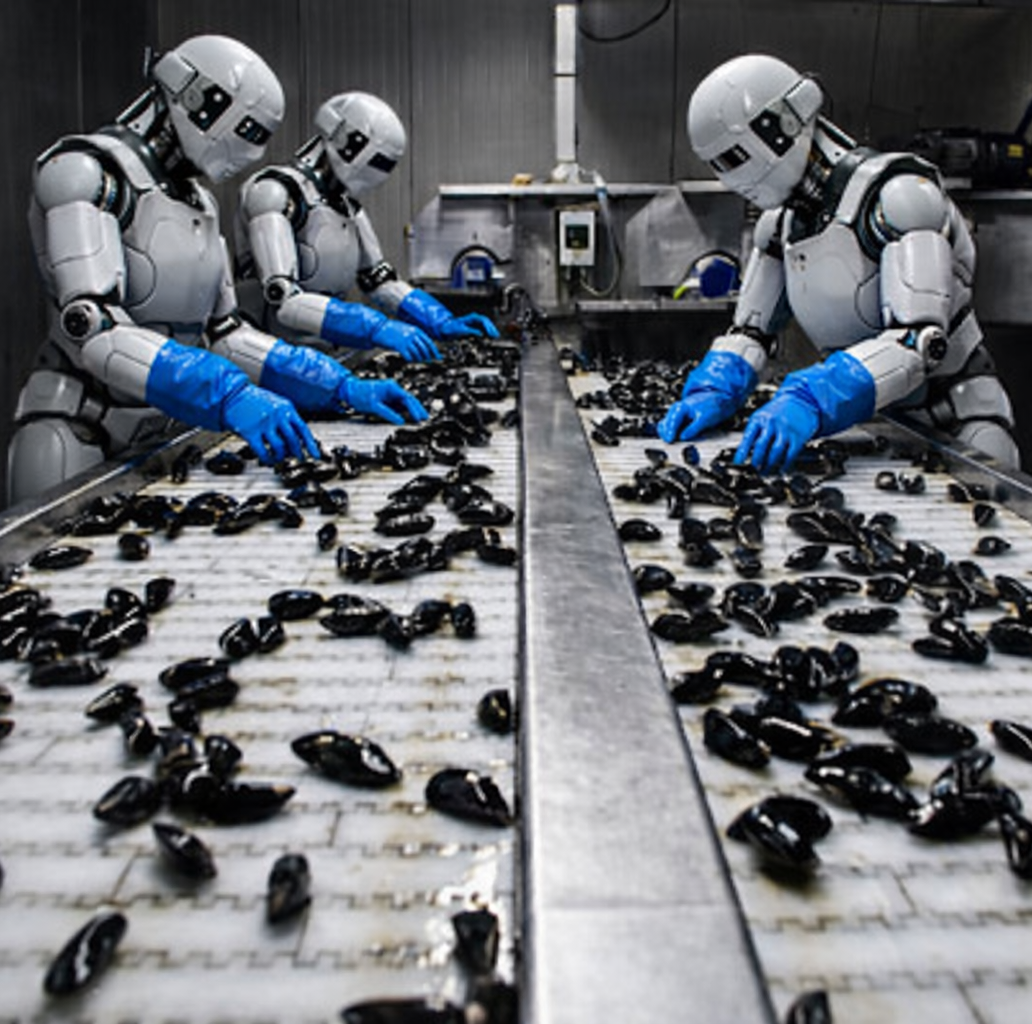
Billions of dollars are flowing into humanoid robotics. Investors are excited. The demos are impressive. But after considering various industries and visiting factory floors across the UK — automotive plants, hardware manufacturers, food processing facilities — a straightforward question keeps going unanswered: what, exactly, is the use case for a humanoid robot?
The Realities of the Factory Floor
Consider food production, a sector facing a labour shortage of roughly one million workers in the UK alone. The operational requirements here are unambiguous: fast, precise, food-grade manipulators that can deposit product into trays or onto tortillas with repeatable accuracy, be disassembled at the end of a run, and put through an industrial dishwasher. Equipment must be IP65 rated. Fully washable. Purpose-built for the task.
Humanoids fail this test before performance is even considered. The fan cooling required to prevent overheating makes any meaningful IP rating unrealistic. And performance? A robot designed to attempt every conceivable task will never match the pick-and-place speed or accuracy of a purpose-built manipulator. Standard industrial and collaborative arms such as FANUC, run 20–22 hours daily with predictable, planned maintenance schedules. No humanoid on the market comes close.
In many cases, the right solution is simpler still: a fixed-arm system docked directly to an assembly line, or a mobile manipulator with task-specific end effectors. The form factor should be the minimum necessary to do the job — not a deliberate imitation of human anatomy.
The Generalisation Tax
Forbes contributor Trond Undheim recently put a name to the cost of ignoring this: the Generalisation Tax — the enormous overhead of building a robot that attempts 1,000 tasks poorly, rather than 10 tasks perfectly. His test for any physical AI investment is blunt: if a system cannot demonstrate reliable performance under real production conditions, it is not a manufacturing asset. It is speculation. A factory runs on uptime, throughput, and predictability. Uncertain performance has no place on an assembly line.
The hardware limitations compound the problem. As Rodney Brooks — co-founder of iRobot and MIT professor emeritus — argued in September 2025, humanoid robots pursuing dexterity through video-based learning represent “pure fantasy thinking.” Human hands contain approximately 17,000 specialised tactile receptors. Humanoid hands have effectively zero. The data infrastructure to close that gap does not yet exist, and every failure in deployment cascades into downtime, retraining costs, and liability exposure that never appears in the demo reel.
The Forbes piece is well worth reading in full.
Form Factor Follows Function
The robotics industry has a tendency to fall in love with hardware before it has identified the job to be done. Humanoids are the latest example. The more useful question — the one being asked on factory floors every week — is not what a robot looks like, but what it needs to do, and what the simplest, most reliable system capable of doing it looks like.
For most manufacturing tasks, that answer is already available: proven manipulators and mobile platforms, selected for the specific environment, fitted with the right end effector, and trained on real-world task data to perform with the consistency and uptime a production line demands. No cooling fans incompatible with washdown requirements. No generalisation overhead reducing performance across the board. Proven hardware, matched to the task, deployed where it is needed most.
That is the principle AIRA deploys in the field — Artificial Intelligence. Real Abilities.